Light Through Stained Glass: What Consciousness Does
You know the moment. You lie in the dark, the day slowly letting go of you, and strange images begin to drift past: a staircase that turns into a sentence, a face you have never seen, a scrap of a conversation that never took place. They make no sense, and they don’t need to. A few seconds later you are asleep.
I have come to see those few seconds as deeply revealing. What we hear then is the orchestra of the brain after the conductor has left the stage, individual instruments suddenly free and playing their own chaotic notes. And if there is a conductor who can leave, the whole question of consciousness changes shape. It stops being a question about some mysterious substance and becomes a question about what that conductor actually does.
A graveyard of beautiful ideas
Consciousness is the greatest mystery of science and the final bastion of metaphysics. For decades the sharpest minds have tried to capture it in a coherent theory, and up close the result resembles a graveyard of beautiful ideas: each one elegant, each one contributing something of value, none of them leading us to the goal.
Most of these theories, as I see it, end up in one of three blind alleys. The seekers of a magical ingredient, from panpsychism to the quantum theory of Orch-OR, look for some special element of reality responsible for experience, a primitive “feeling” in every stone or exotic physics inside our neurons. But they don’t solve the mystery; they merely move it somewhere even less accessible. How would you ever test whether a quark feels something?
The cartographers of shadows, the mainstream of neuroscience, search for the neural correlates of consciousness. We owe them a great deal, from what we know about perception, attention and memory to real progress in medicine. Still, they remind me of ancient cartographers mapping, with incredible precision, the shadows on a cave wall, while saying nothing about the objects casting them. They describe what accompanies consciousness, and then mistake it for the phenomenon itself.
And the illusionists simply declare that the problem doesn’t exist: our inner life is an illusion the brain generates for itself. It is coherent, and deeply unsatisfying, because it denies the only data any of us has with absolute certainty, the fact that we experience something. It is an attempt to cure a headache by decapitation.
If every path leads to a wall, perhaps we have been asking the wrong question.
Stop asking what it is
So let me ask an engineering one instead. Not “What is consciousness?” but “What does it do, and how can we compare that capability across different systems?”
The first step is to untangle a word that has been asked to carry far too much. When we say “consciousness,” we mean two different things at once: the subjective, first-person feeling of being, which I call Consciousness of Self, and the measurable capability of a system to receive, process and understand information, which I call Cognitive Consciousness. Mixing the two up is the source of much of the chaos in this debate.
Cognitive Consciousness can be placed on a map with two axes. The first is scope, the window through which a system perceives reality. We see more colors than a dog, yet in the world of smells we are almost blind beside it. The second is depth, the ability to make sense of whatever comes through that window. Hear a sentence in a language you know and you perceive meaning; hear the same sounds in a language you don’t, and they are only noise. On that map live the senses, the body model (powerful enough to produce real pain in a phantom limb), thought that knows what it knows, and imagination, and the mind weaves them all into one model of reality.
Is this the final word? Certainly not. But it is useful, because it lets us ask concrete questions of any system, biological or artificial. What is its sensory scope? How deep is its understanding in a given domain? Can it model its own states? Those questions have answers.
A camera flash in a dark room
With the ground cleared, I want to propose an architecture of the mind, not as a mystery but as the most perfect system ever created, an engineering solution brilliant in its simplicity. I call it the Main Loop.
It begins with a powerful river of sensory data that never stops flowing. Without a merciless filter we would be paralyzed in an instant, and evolution’s answer is a cascade. First the survival filter, brutal thresholds at the level of the brainstem that sound the alarm before we have time to think. Then the attention filter, natural whirlpools that pull the current toward sudden movement, a loud sound, a face in a crowd. And finally the cognitive filter, channels constantly tuned by our goals and desires. It is the reason a person in love sees the beloved everywhere, and a hungry person smells food from across the street.
What gets through is not processed all at once. Each moment of perception is like a camera flash in a dark room: for a fraction of a second the whole scene is captured in fine detail in a fleeting sensory buffer, and then it begins to fade. Through this room moves a single spotlight of focus. Only what it touches is analyzed at full power; the rest is held together by the brain’s predictive model of the world, which is why we feel we see everything at once. Have you ever watched someone’s face so closely that you missed their words, and then “gone back” to catch them? You weren’t reaching into long-term memory. You were turning the spotlight onto the echo still resonating in the buffer, a moment before it vanished forever.
The illuminated content, set in the context of the world model, becomes a condensed, multimodal prompt fed into the reasoning mind, the analytical and simulating engine at the center. In response it produces a continuous stream of control. That stream moves our muscles and calls up memories, and, most importantly, it retunes the filters and decides where the spotlight will fall next. The mind analyzes the world and, in the same motion, shapes how it will perceive the very next moment. That cycle, running again and again, is the Main Loop.
To coordinate so much distributed activity, the system needs one simple global signal that tells every module whether the loop is running. I write it as system_active=true. My proposal is that our most basic sense of existence is nothing other than the experience of this signal. I call it the Functional Core of Self.
Meditation can be read as a journey to that very source. The practitioner quiets the external senses first, then the itch and the ache in the knees, and finally the hardest layer, the inner dialogue. What remains when everything has been peeled away? A quiet, content-free sense of the engine itself running — and when even that hum fades, we fall asleep. Which brings us back to the orchestra. Sleep isn’t a shutdown but a change of mode: with the loop halted, memory works like a night librarian, moving the day’s books from the reading room to the main archive, and problem-solving circuits make the loose connections that so often hand us a solution in the morning.
The driver, the stained glass and the light
That basic signal is a necessary condition, but it isn’t what we experience as “I.” So where does our uninterrupted sense of being ourselves come from?
We infer it from the evidence. When I drive, I know I am moving, but not because I listen to the engine or study the gauges. I see the landscape passing the window, I feel the vibrations, I hear the hum of the tires. It is exactly the same with the self. I know that I am because I see, hear and touch, and above all because I think and feel. Since perception exists, there must be a perceiver. This is the Inferred Self, solid and effortless, our default mode of existence. It answers the question “Am I?” It doesn’t yet answer “Who am I?”
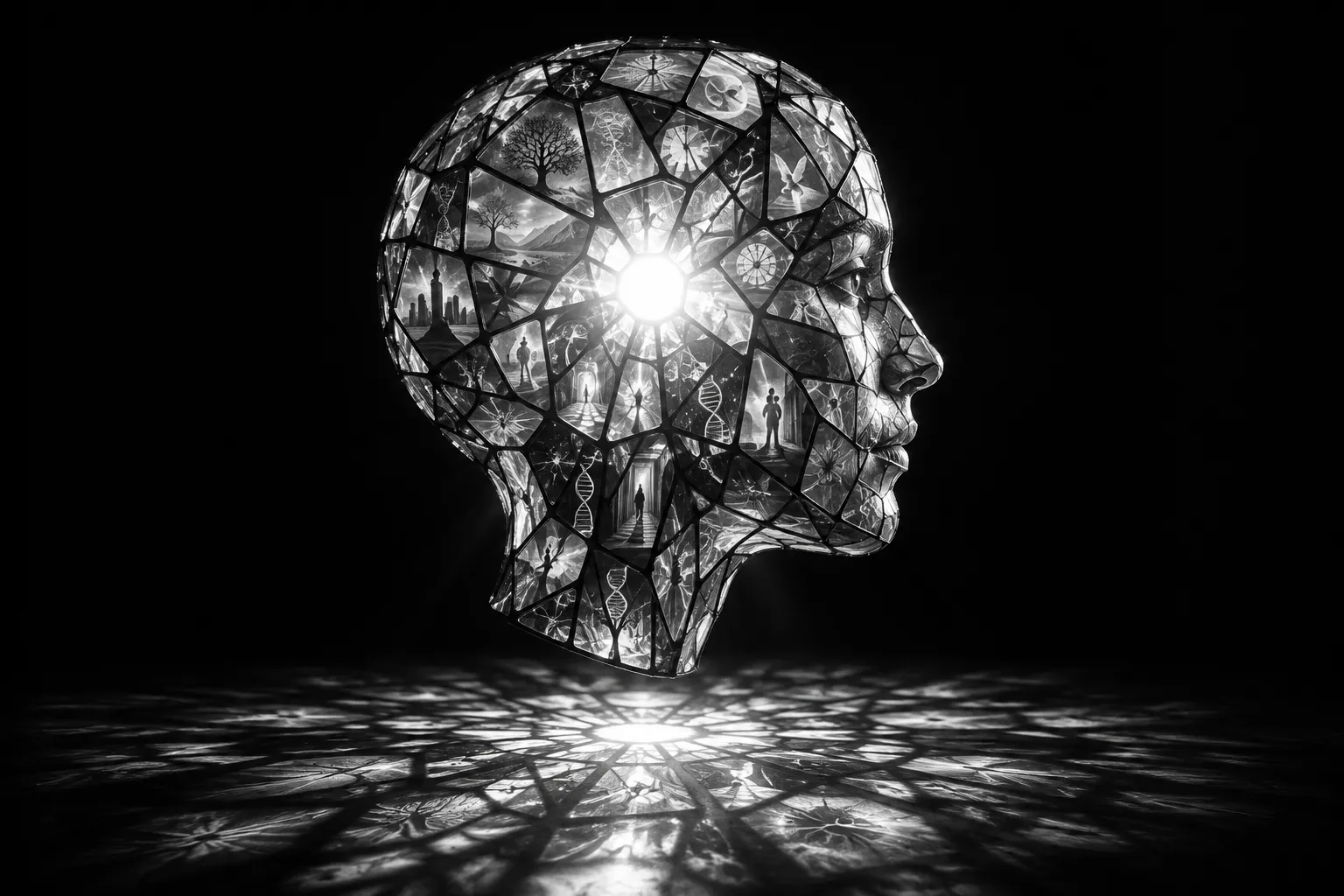
For that we need the third and most human layer, the Stained Glass of Self, made of two models. The Model of Self is our often unconscious theory of what a self is at all: an immortal soul, an emergent property of a neural network, or the three-layered construct I am describing here. The Model of the Person is our answer to who we are as a particular individual: the stories of our successes and failures, our roles as parent, partner, programmer or artist, the values we hold and the things we strive for.
But stained glass, however intricate, stays dark and dead without light. The light is the Functional Core, the raw, constant signal that the system is on. What we finally experience as ourselves is neither the light nor the glass, but the colorful pattern the light casts on the floor of our inner temple. That is why the mystic, the scientist and the artist can share the same light and yet feel their selves so differently. The light is the same for all of them; the glass is not.
The sound a mind makes when it listens to itself
At this point a skeptic usually stops me. “Fine,” he says, “your model describes the machinery. But at the bottom of it all you’ve put a dry technical fact. How on earth does that become a warm, personal feeling of being?”
My answer is that the question rests on a false assumption. Translating information into sensation is precisely the brain’s job; for the brain, there is no such thing as raw, objective information. Think of a brilliant composer who can turn anything — a formula, even silence — into music. When a photon hits the retina, the brain doesn’t see a photon; it plays light and color. When the skin registers damage, it plays pain. And the quiet hum of its own working engine? It plays the simplest melody of all: “I am.” There is no mysterious gap, only translation. What we call consciousness is simply the sound a thinking mind makes when it listens to itself.
Why would evolution build anything so elaborate? Because in a merciless world the best strategy isn’t strength or speed but the ability to predict by reasoning, simulating the future inside a model of the world the way a chess grandmaster plays out variations before he touches a piece. Consciousness isn’t the goal of evolution. It is the operating state in which that reasoning can run, the feeling of being online and planning the next move.
Seen through this lens, the old all-or-nothing question about machines falls apart into smaller ones you can actually check. A large language model has an enormous window onto the digital world, yet it lacks the continuous loop at the heart of this model. It doesn’t exist continuously; it only happens when asked, and stops when the answer is done. Whatever else one concludes, that difference is concrete.
And the model gives something back to each of us. The next time you sit in silence and notice nothing but that quiet hum, or lie in the dark listening to the orchestra lose its conductor, you are looking at your own architecture from the inside. Advanced meditators can even learn, through imagination alone, to feel their self shift outside the body, which shows how plastic our sense of who and where we are really is. The light you were given. The glass, made of what you believe, what you remember and what you choose to strive for, you go on making every day.
Based on Chapter 10, “A Functional Model of Consciousness: A New Architecture of the Mind,” of Silicon Mind by Andrzej Zbroniec.